FoodRaiser! Saturday, April 23rd, 10:00 - 4:00 @ Island Market

Thurston County Progressive Network (TC Pro-Net) is holding their annual "FoodRaiser," which benefits Thurston County Food Bank (TCFB). As a satellite of TCFB, the local St. Christopher’s Food Bank will benefit in the long term from this county wide event, and we encourage your participation, either as a donor, or a volunteer.

We are still looking for volunteers to run 2 hour shifts. Kris Ness is coordinating the Griffin/Steamboat Island area drive for TC Pro-Net. If you are available for a 2 hour shift in front of Island Market, plus a little bit of time to deliver your shift's collections to TCFB immediately after your shift, please call Kris at 360-866-3795. We are looking for up to 6 volunteers, who will work in pairs.

We also have shifts open in other parts of the county, so if you are willing to volunteer at another location once we have our neighborhood covered, please let Kris know as well.

Food Donation Ideas:

  • High protein food such as canned chili, peanut butter, beans, or canned meat.
  • Pasta and Macaroni and Cheese.
  • Canned fruit and vegetables.
  • Soup.
  • Baby Food and Formula.
  • Fresh fruits and vegetables that store well in a refrigerator.

Cash and Checks (payable to "Thurston County Food Bank") will be greatly appreciated.

The Food Bank also has a "wish list" for supplies to support their FORKids program. This program provides weekend food for homeless and needy elementary school children. These children receive free breakfasts and lunch at school during the week and need nourishment for the weekend. The food is supplied by the food bank and put into the child's backpack for the weekend.

  • Oatmeal packets
  • Cup of Soup
  • Fruit cups
  • Small boxes of raisins
  • Vienna sausage
  • Beanies & Weenies
  • Cocoa mix
  • Cold cereal boxes
  • Easy Mac and Cheese
  • Tuna and Crackers
  • Cheese and Crackers
  • Ravioli cups
  • Cup of applesauce

Please, no peanut products, for the FORKids program.

Last year the event raised 3000 lbs of non-perishables, and $4000 in cash donations for the total county, and our site at Island Market contributed roughly 10% of that even we were the smallest location of the 10 locations participating.


Native Plums Bloom - Nature Notes from the Steamboat Peninsula

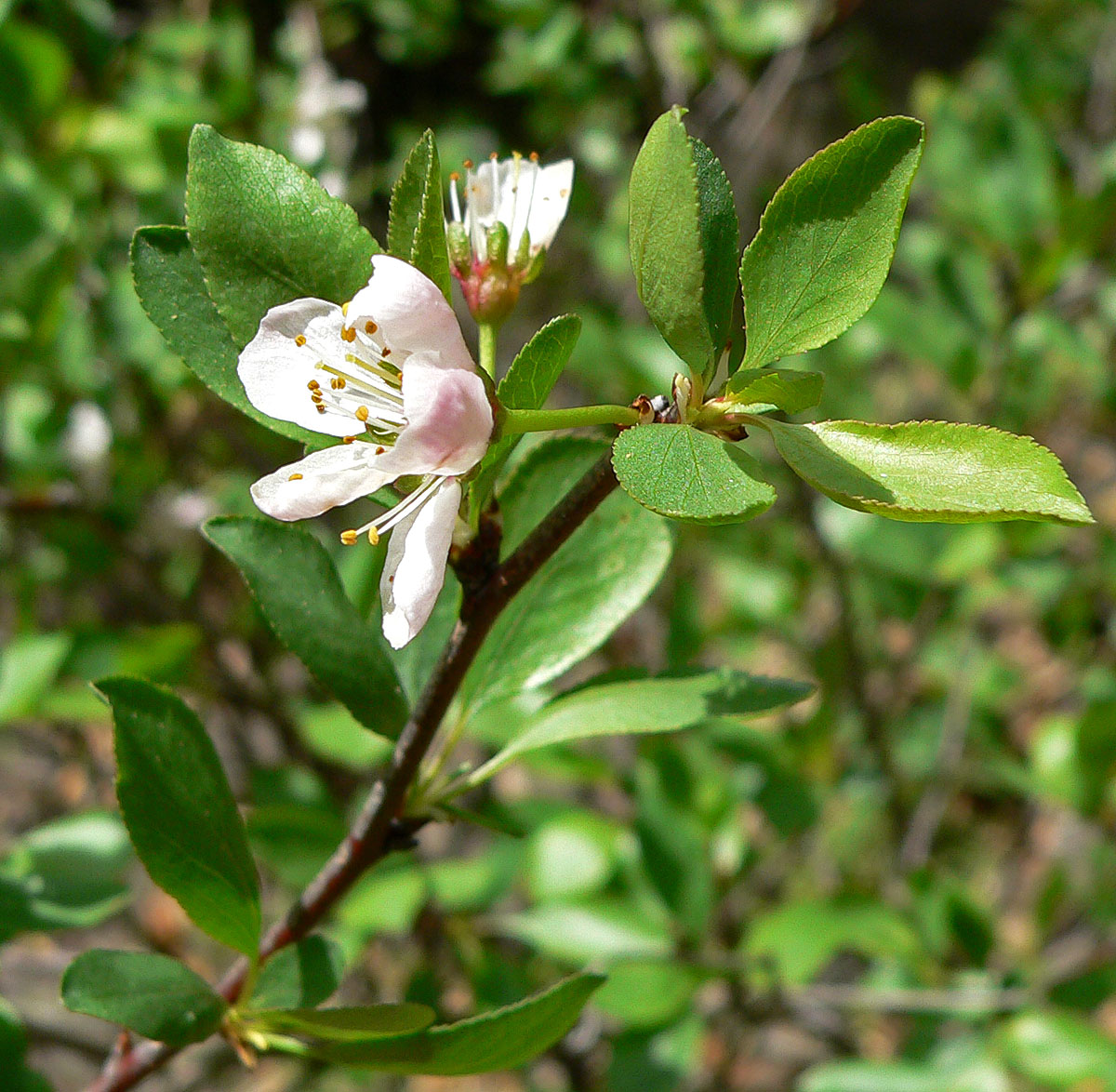
Prunus Subcordata leaves and flowers detail

Prunus Subcordata leaves and flowers detail

Nature Notes from the Steamboat Peninsula is a series for noting and enjoying some of what nature and her admirers are up to in our neighborhood.

Recently the winter woods are breathing pale clouds of color, gifts from various species of Native Plum. Among the candidates for this distinction are the following :

The Northwest Indian Plum, also known as the Pacific Plum, Sierra Plum, Oregon Plum, or technically, Prunus Subcordata. Native to the Northwest and Northern California, this small tree prefers lower elevations but lives at elevations up to 6000 feet. With dense, thicket-like habit, this plum can grow up to 20 feet tall.

Among the first plants to bloom here in the spring, the Northwest Indian Plum is a vitally important food source for another familiar early arrival here; the fiery little Rufous Hummingbird, as well as many other creatures. The white or pink-flushed blossoms first emerge in March or April from gray-barked branches with brown lenticels.

Later, oblong dark red or yellow fruits ripen. Depending on your source, the fruit is described variously as very bitter, very tasty, or tart but edible. Regardless of its insecure rank on human menus, this plum is saluted as a seasonal treat by wildlife.

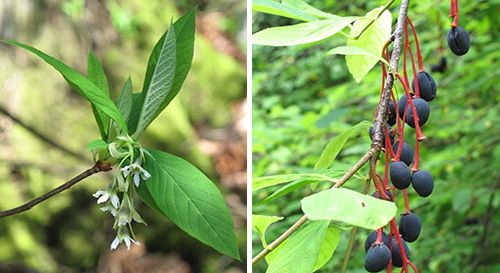
Oemleria cerasiformis

Another native plum, Oemleria Cerasiformis, also blooms in March and April, with whitish-green blossoms. This plum, also known as the Indian Plum or Osoberry, is native to the Pacific Coast and lower elevation Coastal Ranges from the Santa Barbara, California, area north to British Columbia. Westward, it extends its native range to the Cascades.

Shorter than Prunus Subcordata, this plum grows to about three and a half to fifteen feet, with smooth reddish-brown to dark gray bark. Loosely branching habit, leaves that are paler on their lower side, and fresh foliage described as tasting like cucumber help identify this plum.

Pollination requires both male and female plants. The resulting fruits, up to about half an inch long, are initially orange-yellow, but blue-black on red stems when ripe. Among others, deer, rodents and birds feed on these plums.

Oemleria cerasiformis is described as working well in Washington gardens.

--------------

The latest in an ancient line of trees native to these very woods, the native plums we see in bloom today may seem, relative to cultivated species, rather small, even shaggy, and not possessed of the the biggest, most colorful leaves, or showiest blooms. But who among their neighbors, having been graced by their pale end-of-winter blossoms, summer leaves and fruits, or simply their ancient presence as just one of the unique elements our woodlands, could turn down  another Springtime opportunity to celebrate them?

- D. Wiley

Sources: websites for The Washington Native Plant Society; USDA Natural Resources Conservation ServiceWikipedia.


Considering the cost benefits of conserving; Collaboration key to maintaining value of natural money makers

It's not always better to do something rather than nothing at all - or at least that's what proponents of land conservation are trying to teach businesses, government officials and the general public.

It can be a hard concept for some people to understand. But doing nothing to particular plots of land rather than developing them can sometimes save millions, if not billions, of dollars from being spent later on habitat restoration. And many plots of natural land are not just saving money, they are generating dollars.

"It's easier for us to perceive value out of things we sell or do," said Eric Erler, executive director of Capital Land Trust. "We are all responsible for the precarious state of the natural environment. Every square inch of land has a function."

Groups like Capital Land Trust work with landowners who want to conserve, often in an effort to maintain an important function of their property or the overall environmental health of the area.

Examples can be seen around the South Sound. Land owners have signed easements to guarantee their properties will continue to provide things like clean water to the Puget Sound or a safe haven to an endangered species.

And while these deals generally do bode well for Mother Nature, land conservation is not just feel-good environmental work. Many businesses depend on the health of the South Sound's natural environment, especially Puget Sound, for their success.

Economic impact

Erler and other specialists can cite why land conservation is needed in specific cases, but for those folks who are more interested in numbers, a report from Earth Economics shows that the natural systems of the Puget Sound Basin could be valued between $300 billion and $2.6 trillion.

"Valuing the Puget Sound Basin: Revealing Our Best Investments" shows that nature as an economic asset delivers a flow of benefits between $9.7 billion and $83 billion in economic value every year.

The goods and services provided include drinking water production, storage and filtration, flood protection, pharmaceuticals, food, building materials, recreation, waste treatment, climate stability, habitat, biodiversity, nutrient cycling and aesthetic value.

Education

Capital Land Trust has conserved about 55 properties in Thurston, Mason, Lewis and Grays Harbor counties. But Erler said it's the educational side of the business that is challenging.

"What we do is extremely complex," he said. "It doesn't lend itself to a sound bite."

When a business or property owner signs a land conservation contract, they are generally promising that nothing will ever change as far as how that land is maintained. That differs substantially from a company or group promising to "fix" a piece of land.

"It is much more efficient to identify (lands) and conserve them in that state," said Erler, adding that being reactive rather than proactive can be costly.

Erler said an example of people responding too late can be seen at Chesapeake Bay, where money continues to be spent to restore habitat and water quality.

Collaboration

Land use is often a divisive issue, but Erler said part of Capital Land Trust's strategy is to work in collaboration with all interested parties, whether they be shellfish companies, the state Department of Ecology, endangered species groups, large farming corporations or a private land owner.

"Collaboration across the various sectors is the only conceivable way we can all manage the great gift we have in front of us which is the natural resources," said Mike Mosman, senior vice president of land and resources at Port Blakely Tree Farms. "Land trusts provide that central brokerage for making the whole thing work."

Port Blakely Tree Farms is a family business that actively participates in conservation.

"If we were to manage with a short-term view we wouldn't last very long," he said. "We are far better off to address the resource needs with responsibility so that among other things it makes sense and our social license to operate continues."

Forever and ever

Perhaps one of the most intimidating factors for people considering a land conservation agreement is that there is no expiration date. The contracts last forever.

Charlene and Tom Wynne of Wynne Farm said it's nice not to worry about what will happen to their land when they are no longer in control of it. But the couple admits the three-year process was a "huge undertaking."

Wynne Farm will celebrate its 100th anniversary during 2016 and Tom said the easement on the property has not affected using the property as a working agricultural and timberland farm.

Even though the Gordon family's dairy farm has been a long time haven for trumpeter swans, when owner Jay Gordon was approached to conserve about 55 acres for the species, he was hesitant.

Gordon's family has owned the farm for 140 years and he said this type of easement made him feel like in some ways he would be adding another partner to the farm - or at least part of it.

However, Gordon worked with Capital Land Trust, a local trumpeter swan group and U.S. Fish and Wildlife to reach an agreeable land easement contract.

"Part of it was a business decision, part was an ethics decision and part was it didn't really take any skin off our backs," he said.

While some property owners do not receive any financial consideration for conserving their land, Gordon was paid for what his property lost in its estimated sale value and he used the money to help pay for construction of a new barn.

Because Gordon Dairy and Wynne Farm are operating businesses, it was important to both owners that the land easements not interfere with their livelihoods.

Erler said whenever a contract is being negotiated, the trust tries to determine what the owner's goals are for the property.

Typically there is room in a contract for landowners to set their own rules. For example, some like to leave some breathing room for new houses to be built. Others like to prohibit any new building.

"When we conserve a place we do it in a number of ways," Erler said. "It's all (about) what's appropriate for the land."

- Breanne Coats

Reprinted with permission from South Sound Business Examiner
Originally published August 23, 2010
Writer Breanne Coats can be reached at bcoats@BusinessExaminer.com.

Is Puget Sound on a Track to Die Following the Next Wave of Development?

The Thurston County Board of County Commissioners has requested a seminar by Tom Holz on "Why DOE drainage standards will not protect Puget Sound". The seminar will describe how low impact development is the only path to protect the Sound.

If a healthy Puget Sound is important to you, please help persuade Thurston County to adopt low impact development standards by appearing at the seminar on:

Wednesday, March 30, 2011
4:00 PM
Thurston County Courthouse, Building 1

The Washington State Department of Ecology (DOE) appears to be on a path to continue using the same standard for development for the next five to eight years that has been used for the last decade. DOE calls it the "flow-duration" standard. It more accurately should be described as the 0/100/100 standard. That is, DOE will require "0%" forest set-aside, will allow "100%" hardened surfaces, and will allow "100%" runoff of precipitation falling on a site. As almost everyone knows, healthy streams are found in watersheds that are 100% forested. Stream channels begin to destabilize following the clearing of about one-third of its watershed. Thus DOE will allow development that will result in exactly the opposite of a healthy watershed.

At this juncture, there is almost no organized public opposition to DOE’s proposal. Your presence at the seminar will help to signal that there is opposition. Please come.

UPDATE:
If you were unable to attend this meeting, you will find Tom's presentation now on YouTube. It's in two segments. Click here for the first segment, which is 52:35 in length. Fast forward about 4 minutes in, to begin the presentation. Click here for the second segment, which is 14:56 in length.


What can we learn from the Earthquakes in Japan and New Zealand?

Area residents cannot help but think, upon hearing news of earthquakes elsewhere along the Pacific Rim, that it's just a matter of time before something like that happens here. Recently, The Olympian ran an article entitled "Sooner or later, a massive quake will hit Pacific Northwest." About 6 weeks ago, the Griffin Neighborhood Association undertook an effort to rework its disaster preparedness web page, in order to provide a concise set of information. Click here for that web page, which presents information both for families who just want to beef up their preparedness plans and for neighbors who want to work with other neighbors, to craft a more comprehensive approach to disaster planning.

Damage in Japan from earthquake and tsunami

What can we learn from the Earthquakes in Japan and New Zealand?

1. Be Prepared in advance-expect the worst. The level of damage they experienced was difficult to contemplate. Their quakes were a magnitude 7 and magnitude 9. History says we could experience a quake of up to magnitude 9. This fact alone means that all households should have an emergency stock of survival items. Stocks of clothing must include planning for all types of weather.

2. Given certain geological conditions, a tsunami is a potential threat with any earthquake. Often, they are more destructive than the originating earthquake. Note the newspaper headlines after the earthquake in Japan, Northwest and Japan have similar quake and tsunami vulnerabilities.

3. Even though both countries were recognized as well prepared, acute shortages of water, food and gasoline developed within 24 hours. Try to keep all vehicles as fully fueled as possible.

4. Don’t run out of buildings. The amount of rubble should make it clear that you don’t want to leave a building until the shaking and falling have subsided. Move to previously planned safe areas of the building. Become familiar with the angles of survival concept. Move away from windows.

5. Expect major infrastructure failure- roads may be blocked, underground  pipes  (water, septic, gas or propane) may be compromised.

Damage in Christchurch, New Zealand

6. Expect further damage from subsequent after-shocks. Put on safety equipment and, when it is safe, move to open areas. If possible move vehicles to open areas. They may be your temporary home.

7. Maintain an emergency supply of cash on hand.

8. Minimize the use of cell phones. In all likelihood, mobile networks will be compromised with overuse. More importantly, we saw for the first time trapped victims using their cell phones and other electronic devices to lead rescuers to them. Preserve the network for emergency purposes. Texting as a form of communication places the least burden on mobile networks.

9. When things have calmed down place a call to your out-of-area contact and brief them on your status. The Griffin Fire Department has a supply of out-of-area contact forms. We saw the anxiety of family members across the world waiting for news on the status of loved ones.

10. Support your neighbors, particularly those with special needs. There are existing programs and information referenced on this web site to help neighborhoods organize.

- Norm Johnson

Fun with Swallows and Feathers - Nature Notes from the Steamboat Peninsula

By providing the right kind of feathers in the right way, you can easily attract swallows. Every spring, swallows search for the best soft materials to improve the comfort and warmth of their nests. Soft and downy feathers are perfect and swallows get excited when they find a good source.

These birds possess remarkable flying skills. Watching them collect feathers for their nests offers hours of entertainment.

What feathers are best? Birds like the softer downy curved feathers to line their nests. They will not use large-shafted straight tail and wing feathers. Natural colors work well though the swallows can get used to brightly-colored dyed feathers too. Swallows will pick up one-inch feathers but they prefer larger ones. They get quite animated finding a five to seven-inch goose or turkey flank feather. Their nests are about 6 inches wide so one large curved feather goes a long way to cover the bottom, kind of like a wall-to-wall carpet. A big perfect large feather is a rare find so the little birds must experiment to learn how to grab and fly with them.

Swallows will sometimes land to pick up a feather though they usually grab them off the ground while flying since these birds are not efficient hoppers or walkers. When providing nest materials on the ground, just make sure that the area is even, free from obstructions, and has plenty of space for the birds to make their approach and exit flights. Swallows are very cautious when they pick feathers off the ground in flight. Several practice approaches serve to help the bird to know if a feather grab is safe. This makes sense as they are zooming down beak-first at 20 miles an hour to pick up a feather on the ground. They are safer grabbing feathers in the air.

A feather floating in the air instantly attracts swallows looking for nest materials. Provide this and become quickly popular with the local swallows in the spring. With the right wind, launching feathers by hand works well, but usually the plumes drift quickly and disappointingly to the ground. A fun trick is to launch feathers from a ten-foot, one-inch wide plastic pipe. Place a feather at one end and blow into the air from the other end like a dart gun. After a few days, the swallows catch on that airborne feathers are being offered when they see the pipe raised. 

For the larger feathers, the birds have to learn how to catch and fly with them. Early in the season, they make hesitant attempts to catch the bigger five to six-inch feathers. Once they learn how, the birds become adept at mid-air grabs. Both the male and female swallows collect feathers, often working in pairs. Their mouths make a small snap sound when closing or attempting to close on a feather. The swallows also must learn that the best way to fly with a big feather is to carry it curved under the body, shaft-first. So feathers are often dropped mid-air to change to the best position. When this happens the feather may get seized by another swallow and a chase is on.

Barnyard fowl are a good source of feathers. If you know someone who eats their chickens or turkeys, have them save the feathers. Barnyard birds may have parasites like mites. Place future swallow nest feathers in a 0º F. freezer for 48 hours, remove for 48 hours and freeze again for a 48 hours. This kills adult parasites the first freeze, lets any remaining eggs hatch when the feathers are out of the freezer, and kills them during the second freeze.

Once the swallows discover a source for feathers, they will return from nests miles away. Eventually, the birds will recognize you as a consistent feather provider and circle when you come out your door. Once your yard is known as a source, they will return again and again, year after year.

- Chris Maynard

This article originally appeared in last spring’s Echo, the publication for members of Black Hills Audubon.

Chris is fascinated with feathers. He also has a website devoted to images of feathers from around the world, including a few of swallows catching goose feathers in mid-air. He has also produced and is selling an 18”x 24” poster of the alphabet as found in the feather patterns of a single remarkable species of pheasant found in Vietnam and Laos. Some of his 3d framed feathers will be at the Mud Bay Coffee on the Westside during the month of April. His website is featherfolio.com.

Nature Notes from the Steamboat Peninsula is a new series appearing here, noting and enjoying some of what nature and her admirers are up to in our neighborhood. If you have suggestions for topics - or even an entire article you would like see published here, please email webmaster@griffinneighbors.org. And, as always, feel free to leave a comment.

Rufous Announces Spring - Nature Notes from the Steamboat Peninsula

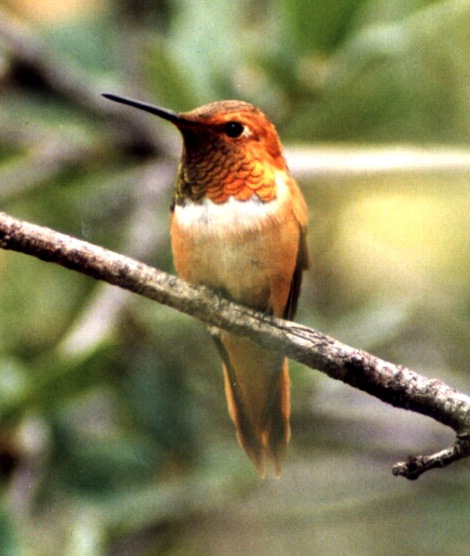
Another seasonal first: that distinctive, loud toy-like buzz of a RUFOUS HUMMINGBIRD zipping around a feeder on Steamboat Peninsula this week. Despite its 3 1/2 inch size (one whole ounce), these birds are described as "tenacious, pugnacious . . . aggressively defending its territory" even against much larger birds. Maybe it's the brilliant coppery iridescence of the male's upper parts, or his also iridescent scarlet-red throat (flashed to further assert his presence) that encourage such bravado. In the rare event of my feeder being empty, these fellows glare in at my kitchen window, wings buzzing loudly, beaks all but touching the glass. No translation necessary.

Bravado indeed: They migrate mainly to the highlands of Mexico, with some wintering along California's southern  coast or along the Gulf Coast. Considered an early migrant, Rufous moves north as early as February, heading as far as southeastern Alaska to breed. By August, their migration all the way back to Mexico begins.

Besides garden feeders, they seek food in a variey of flowering plants and trees, some spiders and insects.

Whether hovering, floating, flashing, buzzing or demanding food service, Rufous is welcome at my place any time, especially when announcing Spring.

Speaking of hummingbirds, I came across a list of their names.  These are real names, like Rufous Hummingbird, although many of them sound more like descriptions of jewels, fairy tale characters or just plain flights of fancy. Although most of these birds live far away, like the tropics, their beautifully feathered cousins right here on Steamboat Island stand well in their stead.

Some hummingbird names to savor:

Green-crowned Woodnymph
Blue-throated Goldentail
Glowing Puffleg
Royal Sunangel
Booted Racquet-tail
Sparkling-tailed Woodstar
Marvelous Spatuletail
Hairy Hermit
Fire-throated Metaltail
Golden Starfrontlet
Velvet-purple Coronet
Blue-tailed Emerald
Green-throated Mountain-gem
Golden-tailed Saphire
Velvet-browed Brilliant
Frilled Coquette
Brazilian Ruby
Crimson Topaz

And there are hundreds more.

- Diane Wiley

Nature Notes from the Steamboat Peninsula is a new series appearing here, noting and enjoying some of what nature and her admirers are up to in our neighborhood. If you have suggestions for topics - or even an entire article you would like see published here, please email webmaster@griffinneighbors.org. And, as always, feel free to leave a comment.


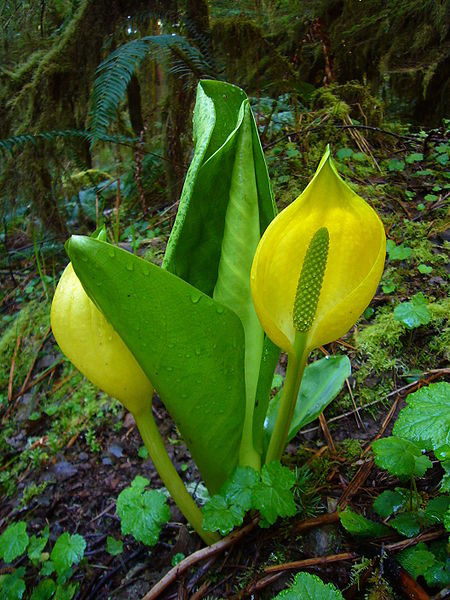
Skunk Cabbage Makes Its Seasonal Debut - Nature Notes from the Steamboat Peninsula

450px-WesternSkunkCabbage

Western Skunk Cabbage

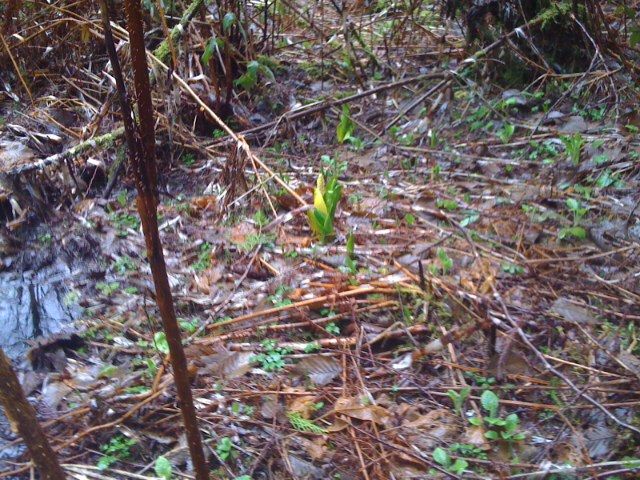
Cheerfully predicting Spring, the humble SKUNK CABBAGE recently made its seasonal debut in Griffin area marshes and creeksides. Of its several other common names, Western Skunk Cabbage, Yellow Skunk Cabbage and Swamp Lantern, perhaps the latter is most descriptive of this plant's big golden yellow "flower," which almost seems to glow in the muted winter woods.

Skunk cabbage near Keating Road

Skunk cabbage near Keating Road

It turns out the "flower" is actually something called a "spathe" - I had to look it up. A spathe is a large bract that forms a sheath around the flower cluster of certain plants, including the Arum family to which our bright Skunk Cabbage belongs.

Despite our Skunk Cabbage's distinctive (as in skunky) aroma, its rich green leaves ( the largest of any native plant in our region), and its big yellow flag signaling Spring make it a most welcome sight.

- Diane Wiley

Nature Notes from the Steamboat Peninsula is a new series appearing here, noting and enjoying some of what nature and her admirers are up to in our neighborhood.

Be A Bird in the Procession of the Species Parade

You could join a flock of shorebirds sponsored by the Black Hills Audubon Society. Here's how:

Have fun at the Downtown Olympia Community Arts Studio making a simple, large, sturdy, light shorebird on a pole. Paint one side white, the other black. Decorate.

In the Parade, the flock turns as one to the high school drummer's beat: Black, then white - just like shorebirds do.

A two-hour workshop: Cutouts, poles,paint and decorating material provided. $5 donation.

The workshop is scheduled for Wednesday, April 6 at 6:30 pm at Downtown Olympia Community Arts Studio.

Expect a fun, informal talk about shorebirds at the beginning of this workshop.

Then, on Wednesday, April 13, we practice our "flocking". If you miss the April 6 workshop, you can make your bird shapes this day instead.

Contact:  Chris Maynard at 878-0755 or the Community Arts Studio at 705-1087.

Or, if being part of part of the parade isn't for you, come and observe our flock and the fantastic array of yet-to-be-imagined Nature in the 17th annual Procession of the Species Parade on Saturday, April 23 at 4:30 pm in downtown Olympia.

Don't forget the beautiful Luminaria Procession on Friday, April 22.

For details - colorful ones at that - about these and other Procession-related events, check out the Procession website at www.procession.org.


Shellfish Growers Organize 13th Biannual Beach Clean-Up

Making this St-Patrick’s Day the greenest ever - shellfish growers and other groups will scour beaches for trash Thursday, March 17th.

For the past six years the Pacific Coast Shellfish Growers Association (PCSGA) has conducted spring and fall beach clean-ups which have removed approximately 72 dump truck loads of debris from area beaches. The mountain of collected debris includes tires, Styrofoam, and a large assortment of public trash.

The targeted clean-up areas will be Henderson, Budd, Eld, Totten, Skookum, Hammersley, Carr and Case Inlets, Oakland Bay, Squaxin and Harstine Islands and parts of Hood Canal. The clean-ups typically involve around a hundred people from about 14 shellfish farms throughout South Sound as well as representatives from the Squaxin, Skokomish, and Nisqually Tribes, Pacific Shellfish Institute and the Washington State Department of Natural Resources.  This week shellfish growers will also be joined by members of Surf Riders Foundation and Standup Paddlers Cleanup. 

Shellfish growers and the tribes provide vessels and fuel. Shellfish companies take turns providing lunch for volunteers. Typically, there are twenty plus boats and crews deployed and approximately 100 miles of beach cleaned up.

In the past 12 clean ups, over 1,000 tires have been removed from beaches.  "It is amazing," said Linda Lentz of Chelsea Farms and a member of the Board of the Griffin Neighborhood Association. Lentz spearheads the clean-up effort for PCSGA. "I don’t know where they keep coming from but we average 80 tires per clean-up".

All of the garbage is brought into common landing sites. One is at the Arcadia boat ramp and a second landing site is at National Oyster Company. Once on shore, the aquaculture debris is separated from the general debris, categorized and counted. PCSGA uses the information to identify the source of any aquaculture debris and work with responsible growers to prevent future releases of the materials from their farms.

Contact PCSGA at 360-754-2744 if you would like more information about this event, if you know of an area that needs attention, or if you don’t want people accessing your beach. Throughout the year, you can also contact PCSGA’s marine debris hotline at 1-800-964-6532.