Here are two videos, presently on YouTube, from last September's encounter with Orcas, off our shores. Enjoy.
Click on the video titles, for more display options.
Many thanks, to the folks who shot these and thought to upload them to YouTube.

Here are two videos, presently on YouTube, from last September's encounter with Orcas, off our shores. Enjoy.
Click on the video titles, for more display options.
Many thanks, to the folks who shot these and thought to upload them to YouTube.
According to this notice, none of the land use actions being contemplated here pertain to parcels within the Griffin area. But, we pass on this meeting notice, nonetheless...
The Tumwater Planning Commission and Thurston County Planning Commission will hold a joint public hearing on Wednesday, January 13, 2010 at 7:00 p.m., or soon thereafter, in Room 152, Building 1 of the Thurston County Courthouse Complex, 2000 Lakeridge Dr. SW, Olympia, WA 98502.
The purpose of the hearing is to accept public comment on proposed amendments to the Tumwater/Thurston County Joint Plan, and for other matters properly related thereto. The amendments are part of an annual update process to the Comprehensive Plan, pursuant to RCW 36.70A.130. The Planning Commission(s) may act on the proposals at the close of the hearing. For land use plan and rezoning amendments, the Planning Commission(s) may recommend a different land use designation and zoning district than indicated. The proposed amendments to the joint plan subject to this hearing are summarized as follows:
1-E Tumwater 2025 Transportation Plan. Adopt the 2025 Tumwater Transportation Plan into the Tumwater/Thurston County Joint Plan. For more information, please contact Tim Smith in the City of Tumwater Planning and Facilities Department at (360) 754-4210, or go to: www.co.thurston.wa.us/permitting/jointplanamendment/
3-E Tumwater Southwest UGA Resizing and Land Use Analysis. A proposed land use plan and rezoning amendment for five distinct areas south of the City of Tumwater in the unincorporated Tumwater Urban Growth Area. The five areas are generally located southeast of Littlerock Road SW, east of Jones Road SW, north of the Hopkins Ditch, and west of Blomberg Road SW; along 83rd Avenue and Interstate 5, and south of the Tumwater city limits. Properties may be removed from the Urban Growth Area and reclassified, and or reclassified to a lower intensity land use designation/zoning district. For more information, including a map, please contact Jeremy Davis, Thurston County at (360) 754-3355 ext. 7010 or David Ginther in the City of Tumwater Planning and Facilities Department at (360) 754-4210, or go to: www.co.thurston.wa.us/permitting/tumwater-uga-analysis/index.htm
4-E Zorad. A proposed land use plan and rezoning amendment proposed by Mark and Teresa Zorad to reclassify Assessors Parcel Number 12716330302 (at 3040 93RD AVE SW, Olympia, WA 98512).
Hard copies of referenced documents and zoning information are available at the Thurston County Development Services Department, Permit Assistance Center, 2000 Lakeridge Drive SE, Olympia, Washington or at the Tumwater City Hall 555 Israel Road SW, Tumwater, Washington and online at the Thurston County Website, http://www.co.thurston.wa.us/permitting/Comprehensive%20Plan/Comprehensive_Plan_Public.htm/
Those wishing to testify should appear and be heard. If unable to attend, mailed and email written comments may be submitted by January 13, 2010 by 4:00 P.M. to Jeremy Davis, Associate Planner, Planning Department, 2000 Lakeridge Drive SW, Olympia, Washington, 98502, email: davisj@co.thurston.wa.us . If you need special accommodations to participate in this meeting, call (360) 786-5489 and ask for the ADA Coordinator. Citizens with hearing impairments may call the TDD line at (360) 754-2933.
*****Staff will be available before the hearing to answer questions from 5:30 P.M. until 6:30 P.M. in the same room.*****
This notice was received from Thurston County via their "GMA Compliance list server." If you know someone who would like to subscribe to the GMA Compliance email listserv, please have them send an email to gma_mail@co.thurston.wa.us.
Emails about GMA Compliance projects sent to gma_mail@co.thurston.wa.us
Please visit http://www.co.thurston.wa.us/permitting/gma for more information. will be forwarded to the appropriate staff member in as timely a manner as possible.
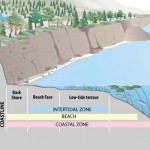
When walking along the beach, have you ever wondered where the gravel and sand come from, why it changes in appearance and texture as you walk along, and why the profile of the beach may change over time? This issue of the Shore Stewards News is a simple primer on where the beach sediment comes from, where it goes to, and how development and human interactions can impact our beaches.

Feeder Bluffs
Much of the shoreline of Puget Sound is rimmed by steep bluffs that range from fifty to several hundred feet high. Looking at the bluff faces, you can see many layers of sand, silt, gravel and clay, which were deposited during the glacial and interglacial periods. These are easy to spot, as they are often of different colors and shades. As these bluffs erode, they provide the building materials that make up our beaches. If you are walking along a gravelly beach, for instance, look at the bluff face, and you are likely to see layers of gravel. As the bluff erodes, whether from slide activity or wave action, the sediment drops to the face of the bluffs, where it is carried along the shoreline by wave and wind action. These primary sediment input areas can feed miles of beaches, creating shore forms such as spits and barrier beaches.
Shore or Littoral Drift
Look at the waves as they move onto the beach. They usually come ashore obliquely, at an angle other than 90 degrees, often determined by the direction of the wind. When these waves strike the shore at an angle, they cause the wave swash (water that washes up on shore after an incoming wave has broken) to move up the beach at an angle. This swash moves the sediment sand and gravel up the beach at an angle. The backwash (the water that rolls back down a beach after a wave has broken) then leaves the shore at 90 degrees, solely under the influence of gravity, taking the sediment with it. This causes a gradual zigzag movement of the particles along the shore, which can increase with storms, tides, and seasons.
This sand and gravel constantly flows along Puget Sound beaches. This littoral drift can move sediment and other materials from bluff erosion and stream deposits to beaches that are several miles in distance. In locations where jetties or man-made structures block this flow of the sediment, sand and gravel can build up on one side of the blockage (accretion) and erode away from the other side.
Puget Sound beaches do not run in a straight line, of course, and the shore drift is interrupted by inlets, headlands, and bends in the shore contours. The shoreline around our islands is divided into several sectors which are often referred to as "drift cells." Each of these cells contains a source, where sediment and other debris are picked up, and a sink, where the sediment is dropped off. In the long term, a single direction of net shore drift may be seen within each cell or sector.
These drift cells are generally independent of one another. Looking at littoral drift as the primary way in which beaches are created and changed, one can see that there are two main feature types. We find bluff-backed beaches, which are the sources of eroded materials, and spit or barrier beaches, where these materials are typically deposited.
Effects of Human Development
It is estimated that there are over 800 miles of bulkheads, seawalls, boat ramps, marinas, docks, and other hardened structures around Puget Sound, equal to about 1/3 of the entire shoreline. Hardened structures can prevent materials from entering the sediment stream, causing erosion downdrift from those structures. This in turn can cause erosion and loss of beach habitat.
A bulkhead does not prevent the beach itself from eroding. The waves reflecting off the bulkheads, particularly those made of concrete, can scour away sediments at the base of the bulkhead. This can undercut the sediment that holds it upright, causing it to lean towards the waves, and possible future failure. This can also cause erosion on nearby beaches. If the bulkhead interrupts the zigzag activity of the littoral drift and halts the transportation of sand up the beach, a sandy beach can be changed into one that only contains cobbles or gravel. In some cases, the beach can be scoured down to bedrock or a hard clay surface. This process may take several years or even decades, but the damage is long-term. This erosion can degrade the nearshore spawning habitats for surf smelt, sand lance, and herring, and ultimately the food sources for salmon and other benthic feeding fish.
There are alternatives to bulkheads, however, such as soft shore armoring. Such alternatives may involve anchoring of large logs parallel to the shoreline, planting of salt-tolerant vegetation, and/or bringing in fill in the form of sand or gravel. Information on these methods can be found in the bibliography. If you are interested in installing soft shore armoring, it is best to consult a professional to assess your situation, as well as performing the design and installation work. This approach does not work in all locations, however, so be sure to investigate your situation to the fullest possible extent.
Click here to view images explaining this information.
Contact your local WSU Extension office for more information:
WSU Mason County Extension
(360) 427-9670 ext 680


 From the Thurston County Sheriff's Office, we received today these Cold Weather Tips:
The Sheriff's Office wishes everyone a very Happy Holiday Season. In recent days we have reached record low temperatures. I would like to provide a few safety tips for this cold weather season.
- Dress in layered clothing and wear some sort of head gear/covering.
- Check space heaters for sufficient ventilation and wire condition.
- Do not use charcoal or gas grills indoors.
- Check on your neighbors - especially the elderly.
- Keep pets inside.
- Never use an electric generator indoors, inside the garage, or near the air intake of your home because of the risk of carbon monoxide poisoning.
- Insulate any water lines that run along outer walls.
- Prepare your home and car for cold weather.
- Have a week’s worth of food and safety supplies.
- Keep a water supply.
- Parents: With the cold temperatures many ponds and lakes are beginning to freeze. While children may feel that it makes for a great place to play, it's actually very dangerous. Please keep your children safe and do not allow them to play on frozen ponds or lakes.
Contact info: If you have any questions, please feel free to contact the Thurston County Sheriff's Office at (360) 786-5500.
 If you read this blog, you have probably already learned of the efforts by some area residents to end hunting on Eld Inlet. A focus of at least one local web site, Eyes Over Eld is to reduce or eliminate the shooting on the Inlet. Last spring, a message thread appeared on Hunting-Washington.com, to discuss the topic. On July 30, a community meeting was held. Hunters, area residents, representatives from the Washington State Department of Fish and Wildlife, and county officials discussed whether a No Shooting Zone or a Controlled Shooting Zone should be established for the southwestern shore of Eld Inlet. Following that meeting, Commissioner Karen Valenzuela committed to engage with hunters, local residents and regulatory bodies in order to, it is hoped, resolve the matter.
For the most part, opinions have come from relatively predictable perspectives. Shoreline residents have complained of noise, water pollution, and even risks to personal safety. Reports of gunfire, shells casings floating up on beaches, and even pellets raining down on the roofs of homeowners have been made public. Hunters have argued they are safely hunting in-season and in the areas permitted by law.
Recently, we received email from an area resident that brings a perspective somewhat different from those we've heard, to-date. This resident writes that many people may not realize important funding for wildlife habitat comes directly from hunters and fishermen. "Licenses and taxes on hunting and fishing gear generate hundreds of thousands of dollars each year for wildlife work."
"Alas, the purchase of a bird field guide or binoculars does not raise even a single thin dime for conservation."
Residents opposed to hunting on Eld have brought up the status of Eld Inlet scoter ducks. There is material, online, which documents a population decline in these ducks. However, "scoter ducks nest in the boreal forests of Canada -- and the single biggest contributor to the purchase of lands to protect nesting habitat has been Ducks Unlimited -- a duck hunter's group. Audubon works very hard on education and legislation but it is generally not in the business of purchasing and protecting scoter habitat."
I spoke, at length, with one of the young men who quickly admitted he was one of the shooters blasting away one Sunday morning. Everything he did was within the laws of the land. However, one can be law abiding and still be rude. He seems to realize that he stirred up a hornets nest with his shooting. It sounds like he and friends will consider hunting further from houses this year. I hope people will give the young men an opportunity to pursue their sport one more season and see if a bit more sensitivity comes with this season.
I have a master's degree in Fish and Wildlife Management and worked for several years for the New Mexico Game and Fish Department. In my last job for them, I was the Big Game Project coordinator. Although I did not oversee waterfowl hunting, I did oversee data collection and season reviews for 13 big game species. I am not a hunter myself but I came to see what role hunters have in wildlife conservation.
Local residents concerned about the environmental impact of hunting would do well to ensure their own house is somewhat in order. The author of this email continues:
Truthfully, Eld Inlet residents who care about wildlife conservation should do the following:
- Remove bulkheads from waterfront property
- Make sure septic systems are not leaking
- Keep cats indoors -- always
- Pick up dog feces from areas within a hundred yards of any water
- Trade powerboats for sailboats or kayaks that do not use gasoline engines.
I write to you as a liberal. To truly be a liberal, in my opinion, is to tolerate those whose value sets and traditions may be different than my own. Eld Inlet fans should keep an open mind to those who see Puget Sound in different ways. Frankly, those who cherish life on the water in winter tend to be duck hunters and oystermen. Their way should be accommodated when possible.
As more information on County action becomes available, we'll be sure to transmit that along, either on this blog or on the web site of the Griffin Neighborhood Association.
What are your concerns regarding shooting on Eld Inlet? Do any of the points made, in this article, resonate with you? Click the "COMMENTS" link, and leave your thoughts, for others to read.

Click to buy the book
Local author Deborah Jane Ross has published a book, just in time for the holidays, about Konrad and Albertina Schneider, entitled Konrad and Albertina.
This is the true story of a German stonemason and his Swedish bride, Konrad and Albertina Schneider, who make their way from Burlington, Iowa to Puget Sound on the Oregon Trail. When Konrad is hired as chief mason for the New Dungeness Lighthouse, he sends for his teenaged nephew, John. The triumphant completion of the lighthouse is overshadowed by tragedy when Konrad and John are arrested for theft.
It is from Konrad and Albertina that we get the name for Schneider Prairie.
Topurchase a copy of Konrad and Albertina, can click on this link and purchase it through Amazon.com (with a portion of Amazon's profits coming to the Griffin Neighborhood Association).
This Saturday, December 5, from 5 to 7 PM, there will be a book launching party, Smyth Landing, 1801 West Bay Drive, Olympia, Washington. Public is invited and refreshments will be served.
Steve Lundin, who periodically contributes material to this blog, has also written about Konrad and Albertina Schneider. Click here to read his piece regarding Schneider Prairie History.

 Steamboat Island Cooperative Preschool is looking for a few lucky children between the ages of 21 months and 3 years to join our Chipmunk class!
Are you looking for a fun and stimulating environment for your child to socialize with other children his or her age? Come visit the Steamboat Island Cooperative Preschool where children learn through play. We are fortunate to have a highly qualified and creative teacher, small class sizes, low child to adult ratio, and a community of supportive families. We are affiliated with South Puget Sound Community College and provide parent education while emphasizing parent involvement in our preschool. The Steamboat Island Cooperative Preschool is a place where children and parents can make lifelong friends in our community.
For more information, please call us 866-1819. We would love to arrange a visit for you and your child.
A free lecture on Rwanda is set for 7:30pm at the Olympia Center on Thursday December 10th. Retired Supreme Court Justice Robert Utter and Betty Utter will describe their fascinating and important work in Rwanda and Tanzania with the International Criminal Tribunal for Rwanda. The Tribunal is a United Nations court established to prosecute those most responsible for the 1995 genocide.
The event is sponsored by the Olympia World Affairs Council. For more information call 360-867-0919.
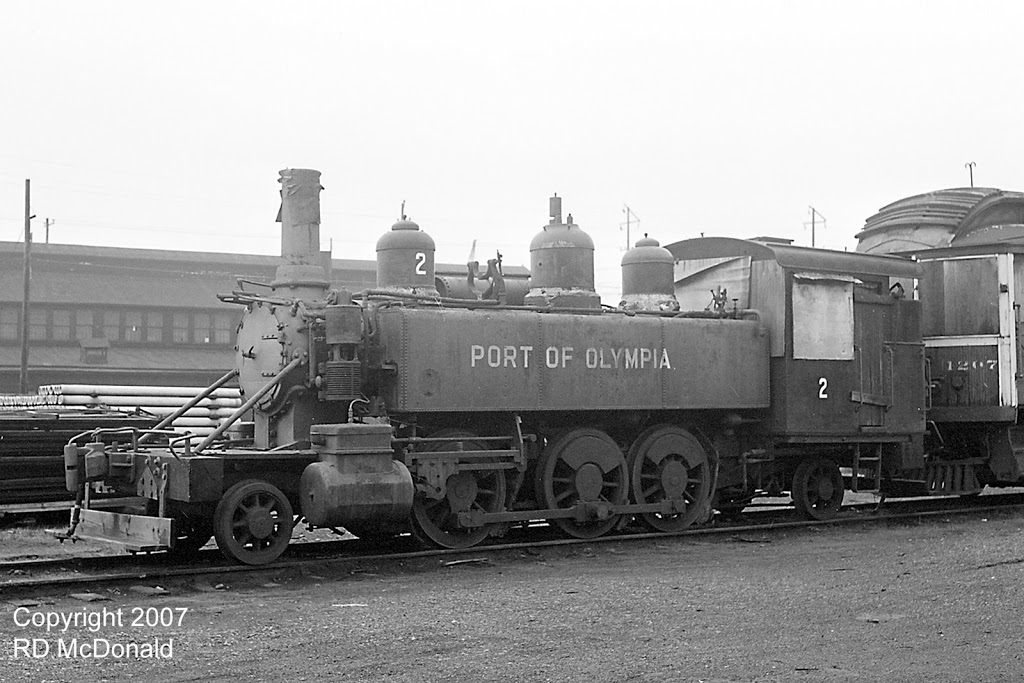 Three different logging railroads served the greater Griffin area many years ago.
These railroads are discussed in Gone But Not Forgotten – Abandoned Railroads of Thurston County, Washington, written by Dr. James Hannum, a resident of our community.
The Puget Sound and Chehalis Railroad was the first railroad. It was also known as the Mosher and McDonald Railroad and then the McCleary Timber Company Railroad. The railroad had 12 miles of track terminating on Mud Bay at the current address of 2144 Madrona Beach Road NW. This site is about 1.4 miles up Madrona Beach Road northwest of the park and ride lot on Mud Bay.
The railroad was constructed shortly after 1888. Soon after Henry McCleary purchased the railroad in 1906, the link to Mud Bay was abandoned after a connection was made from McCleary to the Northern Pacific Railroad. Logs were rolled into Mud Bay from a log rollway running parallel with the shoreline and then rafted to saw mills located on Puget Sound. Two switchbacks took the railroad up the hill around the Indian Shaker Church before the railroad began running westward to McCleary, generally south of what is now Highway 8.
The most remembered railroad serving the greater Griffin area was the Mud Bay Logging Company Railroad. Initially the railroad was called the Thurston County Central Railroad. It was constructed around 1906 and abandoned in 1941.
The Mud Bay Logging Company Railroad eventually had two mainlines totaling 35 miles. An extensive facility was located on Mud Bay where the park and ride lot is now located just east of where Perry Creek enters Mud Bay. Logs were hauled from the company’s logging operations, dumped into Mud Bay, and then rafted to sawmills on Puget Sound. Remnants of several piers may still be seen extending into the Bay north or the park and ride lot. A marker commemorating the facility is located at the northwest end of the park and ride lot.
The initial railroad ran southward from the terminus on Mud Bay, across the county right of way on what is now Madrona Beach Road, and up Delphi Valley on the west side of McLane Creek down to Waddell Creek. Short spurs snaked out from the mainline to serve areas where logging occurred. A branch line was built westward from its original line to serve the company’s operations in the north portion of the Black Hills. Again, a large number of short spur lines were connected to this new mainline.
Dr. Hannum indicates that a third railroad (the Jameson Logging Company Railroad) also served the greater Griffin area running into Summit Lake from the south. Not many records of this railroad remain. It appears to have been built around 1905. This railroad may actually have been a short section of the old McClearly Timber Railroad. A short history of Summit Lake includes a hand drawn map that shows the McClearly Railroad running westward from the northwest shore of Summit Lake and then parallel with Highway 8 toward McCleary.
Bill Durward recalls helping his father take the annual school census for Schneider’s Prairie School District in 1922 or 1923. They traveled by automobile up what is now Highway 8, parked on the side of the road, and walked up railroad tracks leading to company houses on Summit Lake. Presumably there was no auto road leading to the Lake at that time. The northern portion of Summit Lake was located in Schneider’s Prairie School District and remains part of the Griffin School District. Bill recalls the railroad as being called the McCleary Timber Company Railroad. The short connection to Summit Lake probably was soon abandoned as a 1929 Metsker map of Thurston County shows the McCleary Railroad ending several miles west of Summit Lake.
STEVE LUNDIN
Steve Lundin is a long-time resident of the Griffin community located in northwest Thurston County. He received a B.A. degree from the University of Washington and a J.D. degree from the University of Washington Law School and recently retired as a senior counsel for the Washington State House of Representatives after nearly 30 years.
He is recognized as the local historian of the Griffin area and has written a number of articles on local history and a book entitled Griffin Area Schools, available from the Griffin Neighborhood Association at a cost of $10.
Lundin also wrote a comprehensive reference book on local governments in Washington State entitled The Closest Governments to the People – A Complete Reference Guide to Local Government in Washington State. The book costs $85, plus shipping and handling. It is available on the web from the Division of Governmental Studies and Services, Washington State University, at http://dgss.wsu.edu/ or from WSU Extension at www.pubs.wsu.edu .